8.06.2025 MARIS WIGEON AT MAPLEFIELD
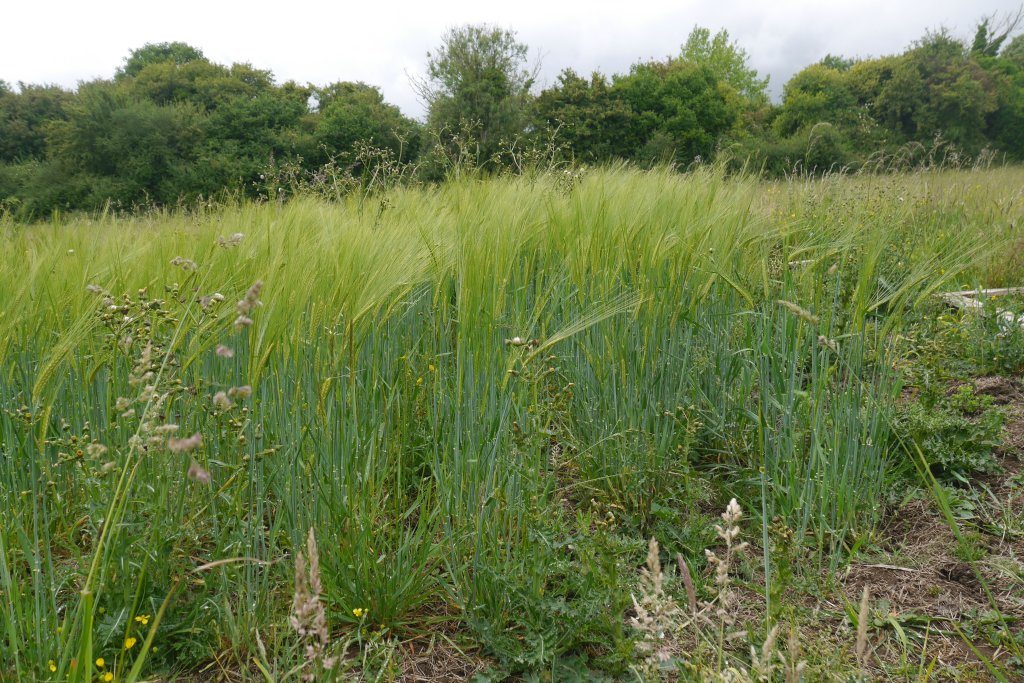
It’s not difficult to write about Maris widgeon wheat; if you want to raise a gramineae forest – Maris will do it. If you’re Maris plants could be perennial, not annual as all wheats are, you’d be made-up. Now more ecocidal cultivations season upon season; no weeds to fight, just a perennial forest emerging from a deep cloak of ‘hay mulch’, which you could graze off with sheep after the harvest if you could be bothered. Our crop of winter sown Maris widgeon has tillered like a coppice since we let the rabbits in, ( Uncle John used to run his flock of Dorset horn ewes over the winter wheat for that purpose in 1968) – a tiller is either a stick of wood attached to a rudder on a sailing boat, or it’s a multitude of vertical shoots from a plant after pruning, or grazing. Each wheat tiller produces an ear of wheat , the more the very much the merrier. So our gramineae (the family to which wheat belongs along with the grasses) forest on Maplefield was sown late by me, owing as much to the weather at the back end of 2024, as to my prehensile idleness. It went in in November, partly because Pete Barnaby was tardy in providing the bag of seed. But it’s there now, bold as you like, with its ‘mulch’ footings holding moisture when there was no rain for 61 days, and no water from me. The plants are a thick mass of pale blue stalks topped with light green, slender linen sales finishing in wisp- drawn awls or whiskers , more barley than wheat, but all wheats used to be ‘bearded’ when they got off the boat from the Tigris/Euphrates, Mesopotamia – successive breeding crosses have left them close shaven. The awl that forms the wonderful, long bristle is designed to protect the grain from predation. Don’t forget – we grew April Bearded wheat a couple of summers ago – now this one, climbing up out of 300 millimetres of mulch, for a sky- burst of wonderful , fresh colours and for the aerial parts of this plant to wave and to rustle to our complete delight, and their image to end up as a screensaver on my desktop computer, to constantly remind me where we have come from – when the first Snelgar got off the boat (4000 years ago) with a linen sack of grain, as bearded as this one. It is quite possible ,and almost certain, that this variety will grow to a height of 5 feet (1500 millimetres) and has a triple use of bread flour, corn dollies and thatching straw, should you need any – and a drinking straw if you need one. And what’s with the name Maris and why the widgeon? Maris comes from Maris Lane and the headquarters of the Cambridge Plant Breeding Institute (Trumpington) and perhaps there was a scientist named Widgeon. It was released and named in 1964 . The point about the tall straw is that the crop crowds out any weeds – I have seen it on 17 acres of high ground above the River Test on Pete Barnaby’s land, where he is interested in the thatching straw not the grain so much. And I love to think of all this – this blue-green strip of heaven comes from someone picking off a few plumper grass seed grains, thousands of years ago and grinding them between stones to see what would happen; then some clever woman added water, the yeasts were there in the air , and the flour rose in a putty lump – onto the fire and the flat breads were formed. Grains have been kept and sown, kept and sown ever since – until 2025 when there are some in the back of the Honda, to grow on , and on and on – for Toby and Seb to eat lovely bread…… and so on. A Snelgar needs a bag of grain close by. Remember – it’s one square metre of ground to grow a loaf. 4840 loaves to the acre at £3/ loaf – do the math ! (£14,520/acre ) – come on.
Nick Snelgar
THE RAGGED ROBIN REVIEW
 Maple Field
Leave a comment